
In 2026, What is a (really) fast website
Written by: Nicolas Prémont - Co-founder & Developer
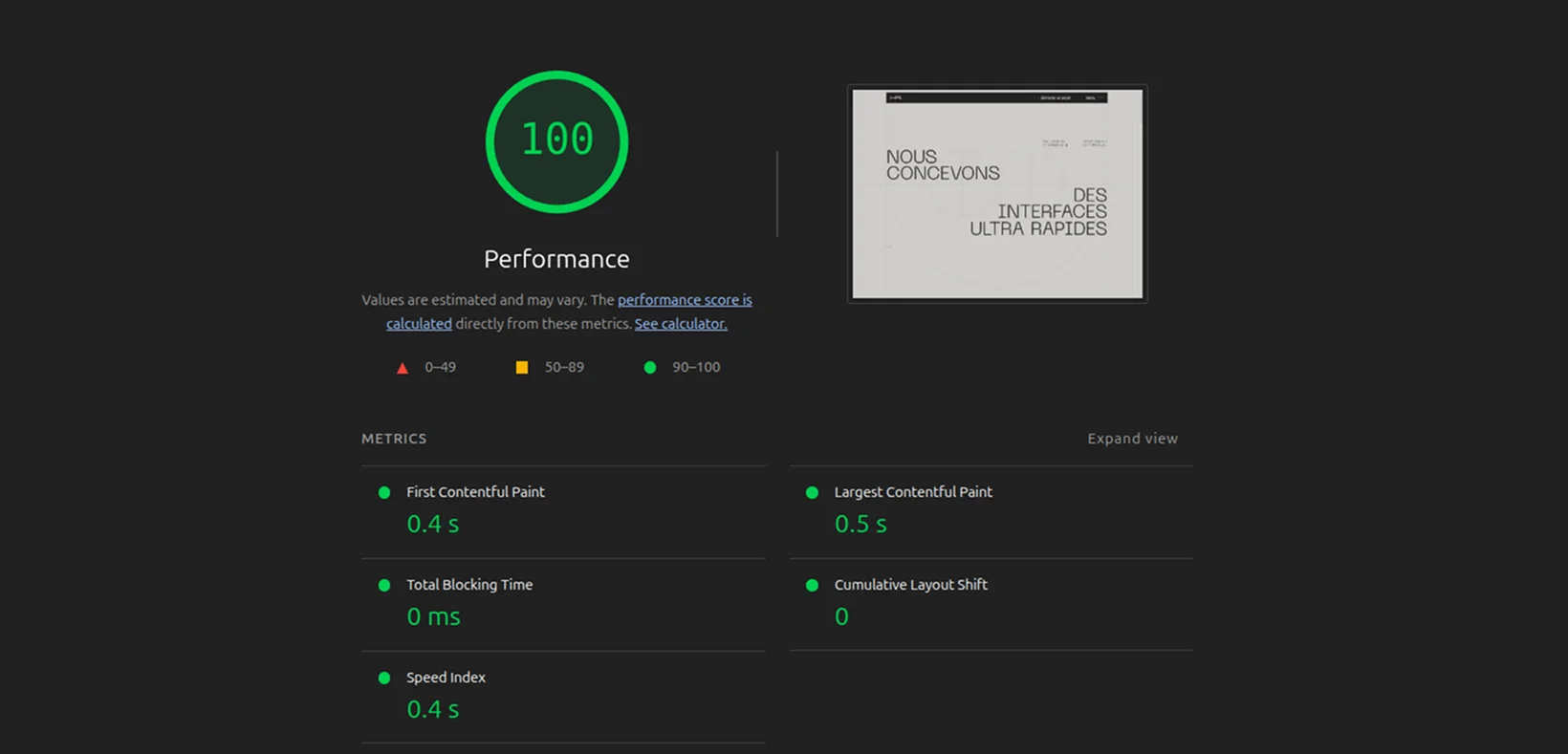
Key takeaways
- / A truly fast website should be evaluated on mobile and under imperfect connection conditions.
- / Speed directly impacts SEO, bounce rate, and conversions.
- / Core Web Vitals, images, caching, and code weight are the main technical levers.
53% of users leave after 3s. A fast site is our standard: instant loading on all devices. Better SEO, better experience.
What is a (really) fast website?
It's simple, you can test it on this site: it's a website that loads instantly, whether you're on a computer, tablet, or mobile, whether you're at the office or on the train with a weak 4G signal.
The reality: More than half of global web traffic now comes from mobile, often with an unstable connection. A site designed for these conditions means fewer visitors leave frustrated.
Why it matters:
Bounce rate: A slow site means a visitor leaves as quickly as they arrived. The numbers speak for themselves: 53% of mobile users abandon a site that takes more than 3 seconds to load (Google). Every second counts.
User experience: Every second of waiting in your purchase journey is an opportunity for your visitors to abandon or postpone, often never returning. Google and Deloitte studies show that even marginal speed improvements can lift conversions, while bounce probability climbs sharply when load time moves from 1 second to 5 seconds.
Users perceive a slow site as less reliable, less professional. Not meeting that expectation means losing trust from the very first seconds.
Organic search: A high-performing site responds better to SEO mechanics. Google includes page experience and Core Web Vitals in its ranking systems. It's not the only SEO signal, but when results are otherwise comparable, a better experience can make the difference.
Digital footprint: A lightweight and fast site runs even on modest devices. It transfers less data, uses fewer resources, and is usually cheaper to operate.
The numbers speak for themselves:
Rakuten 24 measured a 33.13% conversion increase after focused Core Web Vitals work. QuintoAndar linked an 80% reduction in INP to a 36% year-over-year lift in conversions. Housing.com reported 38% more conversions and a 40% lower bounce rate after speeding up its mobile experience.
For an e-commerce site doing €100K/month, a meaningful speed improvement can quickly represent several thousand euros in annual revenue.
The result?
So you get it, a really fast site is better for everyone.
- For you: Easier to maintain, better SEO, users who don't face a technical wall.
- For your users: A smooth experience, a phone that doesn't overheat in 30 seconds of browsing, and a message received without friction.
- For the digital environment: Minimal server costs, a site that works on grandma's smartphone, and relaxed maintenance.
How do we do it?
Optimized code, intelligently compressed images, lazy loading, global CDN, strategic caching. No heavy frameworks, no unnecessary plugins. Just what's needed, ultra-optimized.
Core Web Vitals: Google notably measures performance with 3 key metrics (LCP, INP, CLS). We optimize your site to excel on all 3 indicators.
Test it yourself
Open your current site and this one at the same time. The difference is immediate. Your visitors feel it too, with every visit.
And it just so happens that ultra-fast sites are our standard and what we deliver.
If you want to understand what your site's slowness is actually costing you in conversions and revenue, we broke down the numbers in this article.
Wondering how to apply this to your project? → Contact us
Sources
- /Statcounter - Mobile vs desktop market share worldwide
- /Think with Google - Take Note, Web Publishers: A Speedy Mobile Site Is the New Standard
- /Google Search Central - Understanding page experience in Google Search results
- /web.dev - Milliseconds make millions
- /web.dev - How Rakuten 24's investment in Core Web Vitals increased revenue per visitor by 53.37% and conversion rate by 33.13%
- /web.dev - How QuintoAndar reduced INP by 80%, increasing conversions by 36%
- /web.dev - Housing.com increases conversions and lowers bounce rate by 40% with new PWA